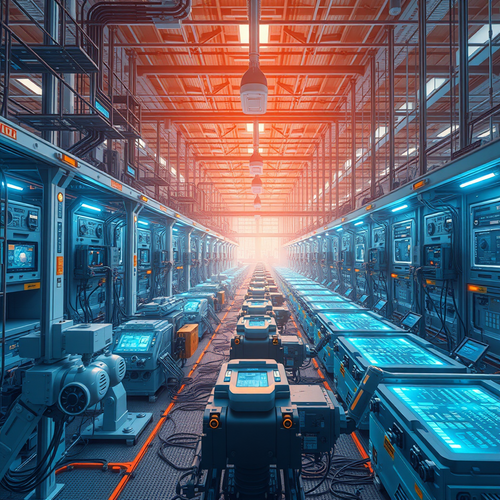
Blackwell: The AI Thinking Machine
NVIDIA’s CEO Jensen Huang unveils the Blackwell architecture, a significant leap in AI computing designed for reasoning models and agentic AI. This new generation of supercomputers, including the GB200 and GB300 systems, represents a fundamental shift in how computers are built and utilized, enabling unprecedented performance and scalability for AI factories and various industries like automotive and robotics.
Points clés
- Moore’s Law provides about two times more performance every 3 to 5 years, while NVIDIA aims for 30-40 times more performance in one generation.
- The new GB200 system weighs two to two and a half tons, has 1.2 to 2 million parts, costs about $3 million, consumes 120 kilowatts, is manufactured in 150 factories, and involves 200 technology partners.
- NVIDIA invested approximately $40 billion in R&D to create the GB200 and GB300 systems.
- The Blackwell architecture is designed as a “thinking machine” that reasons, plans, and engages in internal dialogue, functioning as one giant virtual GPU.
- The MVLink system is a revolutionary memory semantics interconnect and compute fabric that directly connects CPUs and GPUs, offering a bandwidth of 130 terabytes per second.
- The Blackwell architecture results in a significant performance leap over the Hopper generation, enabling higher throughput for AI factories and supporting more users simultaneously.
- NVIDIA is mass-producing these supercomputers at a scale of a thousand systems per week.
- The Grace Blackwell DGX Spark and DGX Station systems bring the Grace Blackwell architecture to desktop and desk-side form factors for developers.
- NVIDIA’s DGX-1, the first AI supercomputer built in 2016, cost billions to develop and initially had no customers until OpenAI, a non-profit startup, expressed interest.
- NVIDIA’s RTX Pro server is designed to run virtually all software, including video games like Crisis, and is powered by Blackwell RTX Pro 6000 GPUs and Super Nix switches.
- NVIDIA’s NeMo platform enhances open-source AI models like Mistral, Llama, and DeepSeek through post-training, reinforcement learning, and extended context.
- NVIDIA has partnered with Perplexity to integrate regional models into their reasoning search engine.
- Agentic AI, a significant advancement from one-shot AI, integrates capabilities like access to real-time data, reasoning, and tool usage.
- NVIDIA’s DGX Lepton system allows users to deploy models across various clouds (Lambda Cloud, AWS, GCP) using a single architecture and deployment method.
- NVIDIA is collaborating with companies like BMW and Toyota to build digital twins of factories and warehouses in Omniverse for simulation and optimization.
- Omniverse is built to create photorealistic and physically accurate digital twins where robots can learn and train.
- NVIDIA provides the full stack for AI-driven robotics, including the computer (Thor), operating system, and AI models.
- NVIDIA’s AV team has won the end-to-end self-driving car challenge at CVPR for two consecutive years.
- NVIDIA’s Halo system for autonomous driving emphasizes safety from chip architecture to testing methodologies.
- Humanoid robots are becoming viable due to advancements in AI learning from digital twins in Omniverse, with partnerships including Disney Research and DeepMind.
- The number of people using inference has increased 100 times in a couple of years, from 8 million to 800 million.
- The next wave of AI, characterized by agentic AI and robotics, will lead to an exponential increase in inference workloads and token generation.
- Europe is significantly increasing its investment in AI infrastructure.
À retenir
So, apparently, the future of computing involves two-ton, multi-million dollar “thinking machines” that talk to themselves and generate “tokens” which, if I understand correctly, are the new food source for little AI robots. And if you’re a developer, and you need a GPU, the answer is always “yes.” Just don’t ask for a glass of whiskey from the robot without arms. It’s an industrial revolution, folks, powered by copper coax and a whole lot of R&D cash. Better start stockpiling those tokens!
Sources
Quiz sur la vidéo: 5 questions