
China’s Underwater AI Data Centers
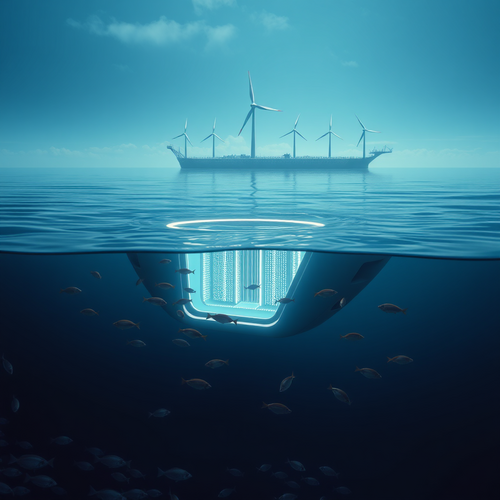
China is pioneering the development of undersea data centers to support its burgeoning AI and digital economy, addressing the significant energy and water demands of traditional land-based facilities. These innovative underwater centers leverage natural ocean cooling and integrate with renewable energy sources like offshore wind farms, positioning China as a leader in sustainable digital infrastructure. Despite environmental concerns, the rapid deployment of these projects by companies like Hailanyun highlights China’s ambitious strategy to “leapfrog” competitors in the global tech race.
Points clés
- China is betting big on artificial intelligence, cloud computing, and other digital technology to grow its economy.
- Traditional data centers consume vast amounts of energy and hundreds of thousands of gallons of water daily for cooling.
- China has begun construction on a wind-powered underwater data center about six miles off the coast of Shanghai.
- Hailanyun (HiCloud) states its undersea data centers use at least 30 percent less electricity than on-land data centers due to natural cooling.
- The Shanghai center will connect to a nearby offshore wind farm, supplying 97 percent of its energy.
- The project’s first phase, costing $223 million, is designed to house 198 server racks (396 to 792 AI-capable servers) and is set to operate in September.
- This capacity is equivalent to training GPT-3.5 in one day, though it’s small compared to typical land-based data centers (3,000 to 10,000+ racks).
- Microsoft pioneered similar technology over a decade ago with Project Natick, finding underwater data centers reliable, practical, and sustainable, with fewer broken servers.
- Hailanyun has moved from a pilot project in Hainan (December 2022) to commercial rollouts in less than 30 months, a pace Microsoft’s Project Natick never achieved.
- Concerns exist regarding localized warming and potential harm to aquatic biodiversity during marine heat waves, though Hailanyun claims minimal impact based on a 2020 test.
À retenir
So, China’s decided to put its AI brains underwater, apparently because land-based data centers are just too thirsty for our precious drinking water. Who knew that keeping servers cool was such a monumental task? It seems they’re taking a page from Microsoft’s old playbook, but with a speed that would make a cheetah blush. While some worry about turning our oceans into warm server baths, Hailanyun assures us it’s all “environmentally friendly.” So, next time your AI chatbot gives you a witty response, remember it might just be chilling (literally) at the bottom of the sea, powered by a gentle ocean breeze. Don’t worry, the fish are probably fine… mostly.
Sources