
Why orchestration will tame multi-agent chaos
Agentic AI will only scale if enterprises shift from scattered, embedded “AI helpers” to standards-driven agents that interact through orchestrators and shared platforms. By adopting A2A and MCP, investing in integration and data fabric, and establishing two pivotal orchestration roles—the doorman for external agents and the concierge for humans—organizations can defragment user experiences and regain control. The strategic edge comes from observability, governance, and model routing delivered by an AI orchestration platform rather than bolting bots onto every app.
Points clés
- Agents are defined as AI systems that pursue goals by reasoning, interacting with environments, and taking actions, increasingly powered by Large Reason Models (LRMs).
- OpenAI’s Operator exemplifies agents that control browsers and desktops; physical agents such as the Unitree R1 extend this to the real world.
- Sustainable interactions hinge on standards: Agent2Agent (A2A) for agent collaboration and Model Context Protocol (MCP) for structured actions and data access.
- The industry faces a choice between embedding black-box AI addons in products versus treating agents as independent entities that integrate via MCP; the article argues for the latter.
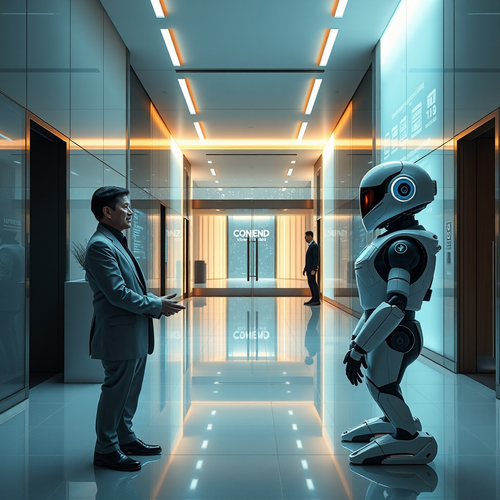
- Orchestrators are essential to avoid fragmented user experiences, culminating in two top-level roles: the concierge (human-facing) and the doorman (agent-facing, enforcing access and triage).
- An AI orchestration platform (akin to Microsoft Azure AI Foundry or ServiceNow AI Control Tower components) is needed to coordinate agents, provide observability/traceability, and enable feedback loops and dispute resolution.
- Observability should approach an AI-era SIEM, logging interactions (including reasoning metadata) and actively challenging agents that act without sufficient context.
- Model routing across a spectrum of models (e.g., OpenAI’s GPT 5, DeepSeek) optimizes cost-performance and enables A/B testing of agents in real workflows.
- Collaboration and work platforms must support MCP; vendors cited include Atlassian (Jira, Confluence), ServiceNow, GitHub, plus large ecosystems such as Salesforce and Oracle.
- Publication context: authored by Matthew L. on Sep 7, 2025, with visible engagement (13 likes, 5 comments), reflecting strong interest in operationalizing multi-agent systems.
À retenir
Start with plumbing, not pyrotechnics: invest in your enterprise integration platform and data fabric before unleashing a small army of chatty robots. Then standardize on A2A and MCP, stand up an AI orchestration platform, and appoint your two VIPs—the concierge for people and the doorman for outside agents—to keep the lobby calm. Do this and your agents will collaborate; skip it and you’ll be stuck negotiating time off with fourteen different bots (and none of them approves it).
Sources