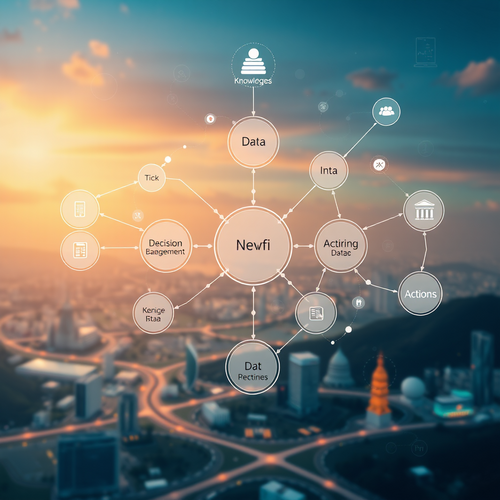

A practical path from prompts to agents
AI is not a zero-sum opponent but a collaborative multiplier—and the fastest wins come from mastering models, prompts, and context to turn better answers into automated actions. The strategic edge lies in context engineering (PART), disciplined experimentation (60-30-10), and scaling outcomes with AI agents and team workflows (TEAM). The goal is augmented intelligence: use AI to test, clarify, and elevate your thinking, while humans lead with EQ.
Points clés
- A LinkedIn poll (6,000+ responses) showed about one third read “how do you compete with AI” as competing against AI, while two thirds read it as competing using AI, reframing AI as collaboration rather than conflict.
- Generative AI relies on large language models that perform next-token prediction; effective use centers on the context window—Prompt, Archive, Resources, Tools (PART)—with modern models supporting up to ~1 million tokens (~750,000 words).
- LLM limitations include training data constraints, hallucinations, and being “frozen in time”; context and tools overcome these via retrieval, browsing, and APIs.
- Recommended frontier models: OpenAI’s ChatGPT (GPT‑5), Anthropic’s Claude, and Google Gemini—any of the three will cover most use cases.
- A practical usage mix: the 60-30-10 rule—60% repetition (what works), 30% iteration (improve prompts), 10% experimentation (new use cases).
- Fast prompt upgrade tip: meta‑prompting—ask AI to improve your prompt with clarifying questions; pair with “custom instructions” to set persona, tone, and preferences.
- Model Context Protocol (MCP) acts like “USB‑C for AI,” standardizing tool access across apps like ChatGPT, Claude, Gemini, and platforms like HubSpot.
- AI agents mark a decade-long shift: HubSpot’s agent.ai grew from 47,000 users at launch to 2 million+; 26,000 people built their own agents, and 1,800 are shared free with the community; supported by Breeze Studio and featured agents.
- Team operating system: TEAM—triage (prioritize high‑impact, low‑risk use cases), experiment (iterate prompts/context), automate (workflows/agents), and measure (outcomes over performative demos).
- A Harvard Business School–Procter & Gamble study found individuals using AI outperform teams without AI on problem-solving quality, while teams with AI produce the best, most creative results—evidence for hybrid human–AI teaming.
À retenir
Start simple: pick a frontier model without overthinking it, set your custom instructions, and meta‑prompt your favorite prompt like it’s getting a spa day. Follow the 60-30-10 rule so your “experiments” don’t become “accidents,” wire in tools via MCP, and build at least one agent this quarter—then run TEAM (triage, experiment, automate, measure) so it’s more system than sorcery. And remember, use AI to upgrade your thinking, not outsource it—because while AI can parse a million tokens, it still can’t fold a fitted sheet or win the pineapple-on-pizza debate without hallucinating.
Sources
Quiz sur la vidéo: 5 questions