
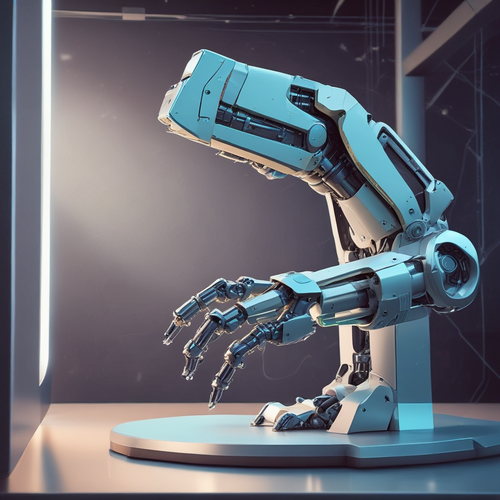
How Spatial Intelligence Is Revolutionizing the Robotics Industry
World Labs, an artificial intelligence startup helmed by industry luminary Fei-Fei Li, has strategically acquired the robotics firm Scenix to accelerate the development of spatial intelligence. By integrating Scenix’s “real-to-sim-to-real” robotic pipeline with World Labs’ generative base model, Marble, the combined entity aims to solve the severe data scarcity plaguing the robotics sector today. This acquisition marks a paradigm shift toward utilizing high-fidelity, geometrically consistent digital simulations to train and evaluate physical robots safely and at scale.
Points clés
- World Labs is a two-year-old AI frontier startup founded by Fei-Fei Li, primarily focused on building large world models and advancing spatial intelligence.
- The company recently acquired Scenix, a robotics startup co-founded by Columbia University assistant professor Yunu, to integrate physical action capabilities into their digital spaces.
- World Labs has developed a generative AI model codenamed “Marble,” capable of translating prompts into geometrically consistent 3D environments.
- Prior to the official acquisition, Scenix was remarkably already paying as a direct customer to use the early versions of the Marble model.
- Scenix has pioneered a “real-to-sim-to-real” pipeline that creates highly accurate digital twins of physical environments for robotic training and evaluation.
- Evaluating robotic models in physical environments is currently multiple orders of magnitude slower, more dangerous, and costlier than iterating on traditional language models.
- According to a survey conducted by Yunu and Fei-Fei Li, one-third of the tasks the general public actually wants robots to perform involve cleaning.
- Autonomous vehicle giant Waymo utilizes billions of hours of simulation, proving that digital counterfactual reasoning is fundamentally required for real-world navigation.
- The strategic merger allows robotic systems to leverage simulated randomizations—like varying lighting and physics—to achieve massive evaluation speeds before touching physical hardware.
- Driven by the new acquisition, World Labs is officially transitioning into a bi-coastal operation with headquarters in San Francisco and a brand new office in New York.
À retenir
If you operate in the robotics space, my top recommendation is to immediately stop trying to train your incredibly expensive metal contraptions by watching them clumsily drop objects in the real world at a glacial pace. Instead, embrace the magic of digital “spatial intelligence” where your robots can crash tens of thousands of times in a simulated universe without costing a dime in physical damages. Just do not hold your breath waiting for a flawless, human-level android to navigate the unstructured disaster zone that is your living room anytime soon; even the brightest minds in frontier AI quietly admit that a highly efficient robotic butler is still a distant pipe dream. Keep your mop firmly in hand for the foreseeable future.
Sources
Quiz sur la vidéo: 5 questions