
How we turn creative theory into targeted learning
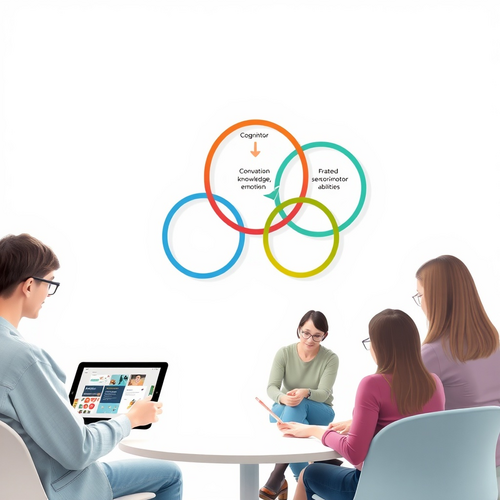
We present ATHENA, a systemic competency model that reframes creativity as emergent, agentic behavior coordinated across cognition, conation, knowledge, emotion, and sensorimotion. Operationalized through 60 facets and four mastery levels, the model powers a digital platform—Skills, Profile, Learn—that aligns real job demands with cohort context and targeted pedagogies. Two creative work cases (graphic design and workshop facilitation) show how ATHENA links abstract competencies to concrete, AI‑assisted training design, with empirical validation and scalability as next steps.
Points clés
- ATHENA defines competencies as agentic, emergent behaviors coordinated across five dimensions—cognition, conation, knowledge, emotion, and sensorimotion—structured into 60 facets and four mastery levels.
- The platform operationalizes the model via three modules: Skills (task requirements mapping), Profile (cohort/context constraints), and Learn (pedagogical repertory and sequencing).
- Semantic interoperability is built through ESCO alignment, with NLP and a conversational assistant guiding precise skill formulation.
- Case study 1 (graphic design) prioritizes facets such as technical expertise, divergent thinking, hand–eye coordination, sustained attention, declarative knowledge, and behavioral flexibility.
- Case study 2 (workshop facilitation) highlights behavioral flexibility, self‑regulation, knowledge transfer, emotional perception, sustained attention, and intrinsic motivation.
- ATHENA Learn catalogs 200+ teaching techniques, mapping methods to ATHENA facets and mastery levels across synchronous/asynchronous, in‑person/online formats.
- Generative AI (ChatGPT‑4o, Claude 3.1) assists recommendations; human experts review and refine all outputs to keep pedagogy accountable.
- An initial study with ~50 instructional designers from 3 organizations is underway to assess relevance and enrich activity proposals.
- Funding was provided by Groupe Bouygues, Decathlon, and Crédit Mutuel Alliance Fédérale; authors are affiliated with Tomorrow Theory, Aix‑Marseille University, Université Paris Cité, and Univ Gustave Eiffel.
- The current release is declarative (no real‑time adaptive learning loop) and open access under CC BY 4.0, with future work focused on validation, scalability, and cross‑cultural applicability.
À retenir
Start simple: map one real task to a handful of ATHENA facets, profile your cohort’s constraints, then pilot two or three high‑leverage activities from Learn. Measure before/after, keep the human in the loop, and resist the urge to laminate a 60‑facet dictionary. And yes, let AI help—but remember your spreadsheet doesn’t have feelings; your learners do.
Sources