
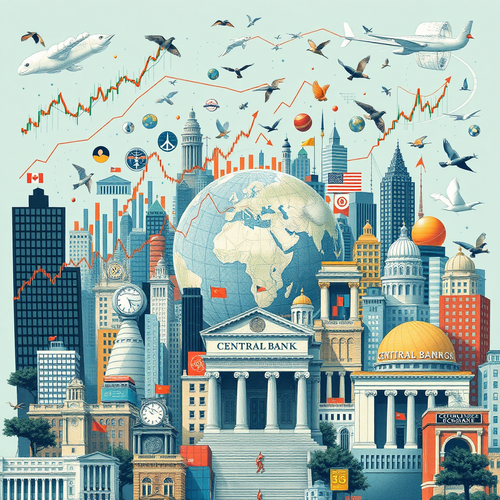
Navigating 2025’s Economic Landscape
This report provides a concise overview of key macroeconomic developments and investment perspectives for the first half of 2025. It analyzes bond market tensions, the impact of US trade policy, and shifts in investor sentiment across different asset classes and regions. The report highlights opportunities and risks in equities, fixed income, and currencies amidst evolving geopolitical and economic landscapes.
Points clés
- The Japanese 40-year bond yield reached a 20-year high of 3.46%, while the UK 30-year yield hit 5.50% and the US 30-year yield neared 5%.
- According to OECD data, Japanese debt is sustainable, with interest payments representing only 0.23% of GDP at the end of Q1.
- The Bank of Japan holds 46% of the total stock of Japanese sovereign bonds.
- France faces bond market tensions due to high debt and sluggish growth, estimated at 0.6% in 2025 by the European Commission.
- Nvidia is investing in quantum computing through Californian startup PsiQuantum.
- Nvidia will publish its Q1 financial results on May 28th, with China, Taiwan, and Singapore being key buyers of its processors, while Europe is “invisible.”
- For the first time in 25 years, the British hold more US Treasury bonds than the Chinese.
- The US primary deficit could increase by up to $5.8 trillion over the next ten years, potentially doubling the debt growth rate.
- The US federal debt could reach $59 trillion, or 134% of GDP, in 2034, and 211% in 2055, according to initial estimates.
- The Reserve Bank of Australia is expected to lower its key rate by 50 basis points, marking the largest monetary easing cycle outside of a recession in decades.
À retenir
So, the bond market is a bit jumpy, the US debt situation is looking… enthusiastic, and apparently, the British are now the proud owners of more US IOUs than China. Meanwhile, Nvidia is off chasing quantum computing butterflies, and Europe is apparently too busy to buy their chips. The good news? The energy transition is happening despite what you might hear, and maybe, just maybe, the Swiss National Bank will bring back negative rates so we can all feel like we’re getting paid to borrow money again. Don’t worry, it’s probably fine. Probably.
Sources